
School of Electrical Engineering & Computer Science
Shape the future of our world with hands-on experience and real-world innovation.
Electrical engineering and computer science come together at UND's School of Electrical Engineering & Computer Science (SEECS). Across five areas of study, students build technical skills to innovate in some of today's most in-demand fields.
National Security, on Campus
SEECS also houses the Mark & Claudia Thompson National Security Corridor, the newest hub for national security and space activities at UND. Students train in satellite fabrication, environmental testing, radar research and big data. The mission of the security cooridor will continue to expand with new machine vision and cybersecurity labs on the way.
Mark & Claudia Thompson NATIONAL SECURITY CORRIDOR
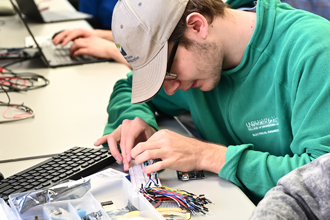
Electrical Engineering
Powering what's next. Get hands-on with circuit design, electric drives and embedded systems, then launch a career in aerospace, robotics, renewable energy and beyond.
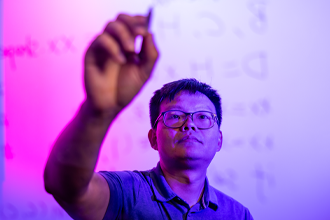
Computer Science
Code with real impact. Our program teaches you to model problems, design solutions and verify results, with hands-on opportunities in AI, cybersecurity, web and mobile apps, big data and video game development.

Cyber Security & Cyber Security Engineering
Protect what powers life. Whether you defend data and networks or design infrastructure built to withstand attack, UND prepares you to safeguard the systems modern life depends on.

Data Science
From data to decisions. Our program blends computer science and business analytics, so you can turn data into decisions in fields from agriculture to healthcare. A senior design project with industry partners puts your skills to the test.
Programs Offered

Accreditation
The Bachelor of Science in Electrical Engineering (BSEE) program is accredited by the Engineering Accreditation Commission of ABET.
The Bachelor of Science in Computer Science is accredited by the Computing Accreditation Commission (CAC) Accreditation Commission(s) of ABET, under the General Criteria and the Computer Science Criteria.
The last ABET accreditation visit was in November 2021 and the next visit will be in 2027.
Mission Statement
Our mission is to educate, inspire, and enhance the competitiveness of our graduates through integration of teaching and collaborative research focused on scientific innovation and discovery.
Educational Objectives
The following Program Educational Objectives have been established by the school, its advisory board and students:
- Graduates will successfully practice Electrical Engineering and related fields regionally, nationally and internationally.
- Graduate will continuously pursue professional development.
- Graduates will function effectively, responsibly and ethically in diverse and global work environments.
- Graduates will succeed in further graduate and professional studies.
ABET Student Outcomes
- An ability to identify, formulate, and solve complex engineering problems by applying principles of engineering, science and mathematics.
- An ability to apply engineering design to produce solutions that meet specified needs with consideration of public health, safety, and welfare, as well as global, cultural, social, environmental and economic factors.
- An ability to communicate effectively with a range of audiences
- An ability to recognize ethical and professional responsibilities in engineering situations and make informed judgments, which must consider the impact of engineering solutions in global, economic, environmental and societal contexts
- An ability to function effectively on a team whose members together provide leadership, create a collaborative and inclusive environment, establish goals, plan tasks and meet objectives
- An ability to develop and conduct appropriate experimentation, analyze and interpret data and use engineering judgment to draw conclusions
- An ability to acquire and apply new knowledge as needed, using appropriate learning strategies
Enrollment and Graduate Data
| Academic Year | Undergrad Enrollment* | Degrees Awarded |
|---|---|---|
| 2024-2025 | 320/316 | 34 |
| 2023-2024 | 284/286 | 28 |
| 2022-2023 | 308/270 | 38 |
| 2021-2022 | 284/273 | 39 |
| 2020-2021 | 302/290 | 29 |
| 2019-2020 | 297/312 | 47 |
| 2018-2019 | 228/251 | 53 |
*Indicates Fall/Spring enrollment numbers
Educational Objectives
The following Program Educational Objectives have been established by involving all program constituencies.
Graduates from the Computer Science undergraduate program will:
- Have sufficient knowledge and skills in the foundations and application of computer science to be successful in employment or in graduate school.
- Be guided by ethical principles in their careers
- Be prepared to assume leadership roles in professional and community life
- Be aware of the need for continuous, life-long learning
ABET Student Outcomes
Graduates of the program will have an ability to:
- Analyze a complex computing problem and to apply principles of computing and other relevant disciplines to identify solutions.
- Design, implement and evaluate a computing-based solution to meet a given set of computing requirements in the context of the program’s discipline.
- Communicate effectively in a variety of professional contexts.
- Recognize professional responsibilities and make informed judgments in computing practice based on legal and ethical principles.
- Function effectively as a member or leader of a team engaged in activities appropriate to the program’s discipline.
- Apply computer science theory and software development fundamentals to produce computing-based solutions.
Enrollment and Graduation Data
| Academic Year | Undergrad Enrollment* | Degrees Awarded |
|---|---|---|
| 2024-2025 | 213/174 | 30 |
| 2023-2024 | 211/200 | 22 |
| 2022-2023 | 200/185 | 26 |
| 2021-2022 | 169/157 | 25 |
| 2020-2021 | 179/144 | 35 |
| 2019-2020 | 177/155 | 35 |
| 2018-2019 | 169/154 | 37 |